Your Cart
There are no items in your cart.
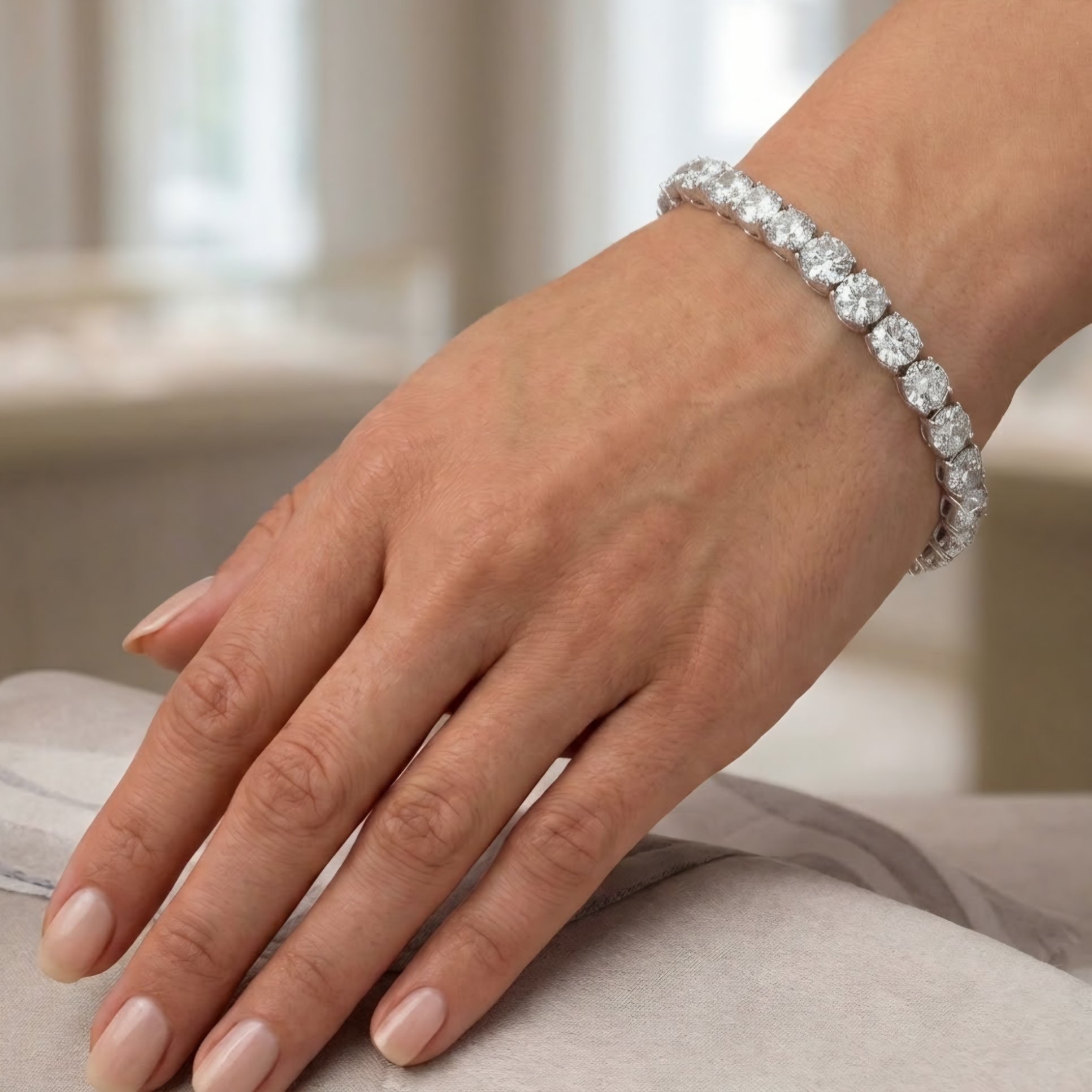
Short answer: a tennis bracelet is a flexible bracelet made of a single, continuous line of matching diamonds (or other gemstones), each set in its own small mount and linked to the next. It got its name in 1987, when tennis star Chris Evert’s diamond bracelet broke during a U.S. Open match and play stopped while she looked for it. You can see our styles in diamond tennis bracelets.
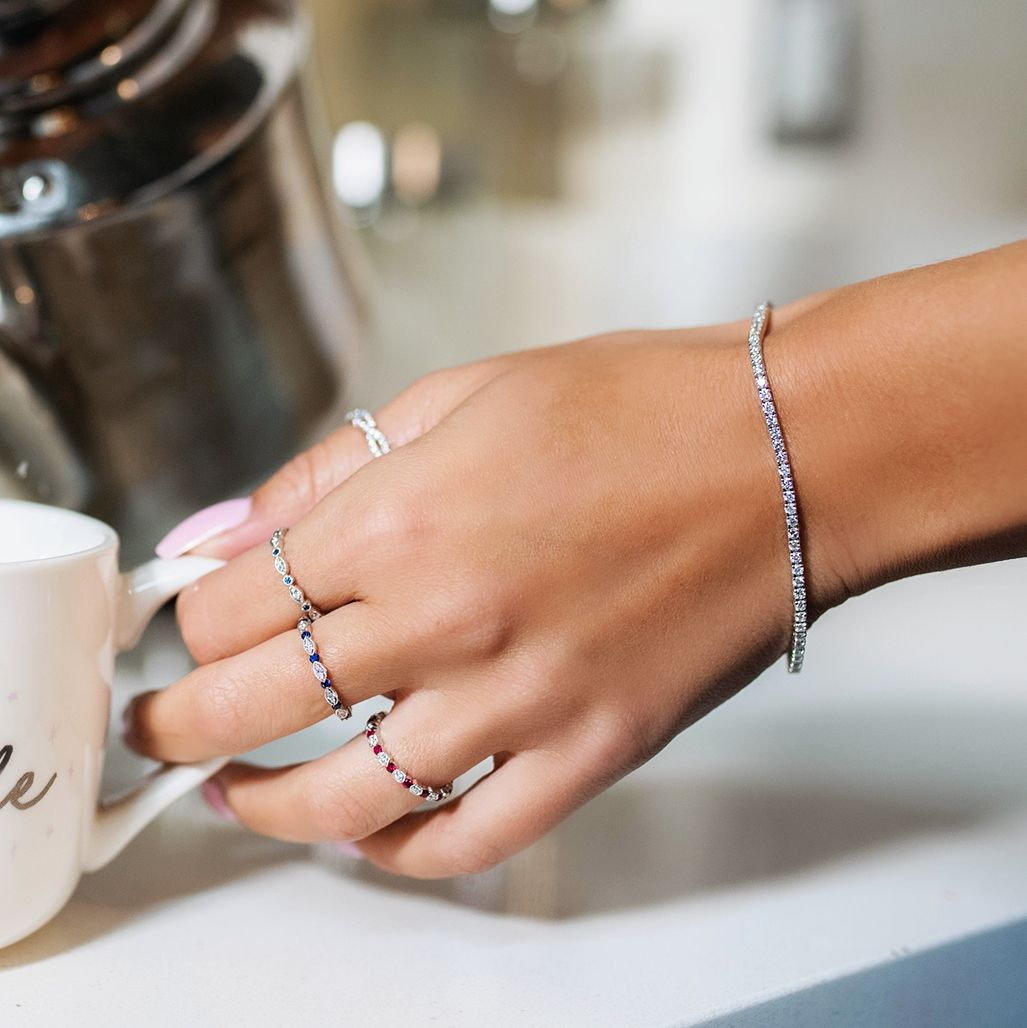
Before 1987, this style was usually called a line bracelet or an eternity bracelet. Then, as GIA tells the story, Chris Evert was wearing her diamond line bracelet during a match at the U.S. Open when the clasp broke. She asked for play to be stopped so she could find it. The moment was widely covered, and “tennis bracelet” stuck.
It’s a good story, and there’s a lesson in it too: a tennis bracelet is only as secure as its clasp. More on that below.
A slim line of same-size diamonds that goes all the way around the wrist. Because each diamond has its own mount joined by a small hinge, the bracelet moves like fabric and lies flat on the wrist. There’s no big centerpiece. The beauty is in the even, unbroken line of sparkle.
Most tennis bracelets use round diamonds, but emerald, oval and pear shapes make lovely alternatives. An emerald cut tennis bracelet has a cleaner, more architectural look; ovals and pears set east-west (sideways) look softer and more unusual.
| Setting | How it holds the diamonds | Look and feel |
|---|---|---|
| Four-prong | Four small claws per diamond | The most diamond showing; classic and bright |
| Three-prong (martini) | Three claws in a triangle | Stones sit close together; lots of sparkle |
| Bezel | A rim of metal around each diamond | Smooth, snag-free, very protective |
| Channel | Diamonds set between two metal walls | Sleek and flush; very secure |
Four-prong is the classic choice because it lets in the most light. Bezel and channel are good for anyone who wears their bracelet every day and doesn’t want it catching on knitwear.
Tennis bracelets are described by total carat weight: the weight of all the diamonds together. A 5 carat bracelet with smaller diamonds has a delicate line; a 10 or 15 carat bracelet has bigger individual stones and a bolder look. Ask for the size of each diamond, not just the total.
Because every stone sits next to its neighbors, the diamonds need to match in color, clarity and size. One slightly yellow or cloudy diamond stands out in a line of white ones. This matters more than having the highest grade.
This is where tennis bracelets differ the most from one jeweler to the next. In our GIA-certified tennis bracelets, such as the 10 carat round, 15 carat round and 20 carat emerald cut bracelets, every diamond is 0.30 ct or larger, and every one is GIA-certified and precisely matched. Most jewelers don’t offer this on tennis bracelets. On bracelets with smaller diamonds, the stones are usually hand-matched rather than individually graded, so ask which you’re buying. Our guide to certified vs non-certified diamonds explains what a report tells you.
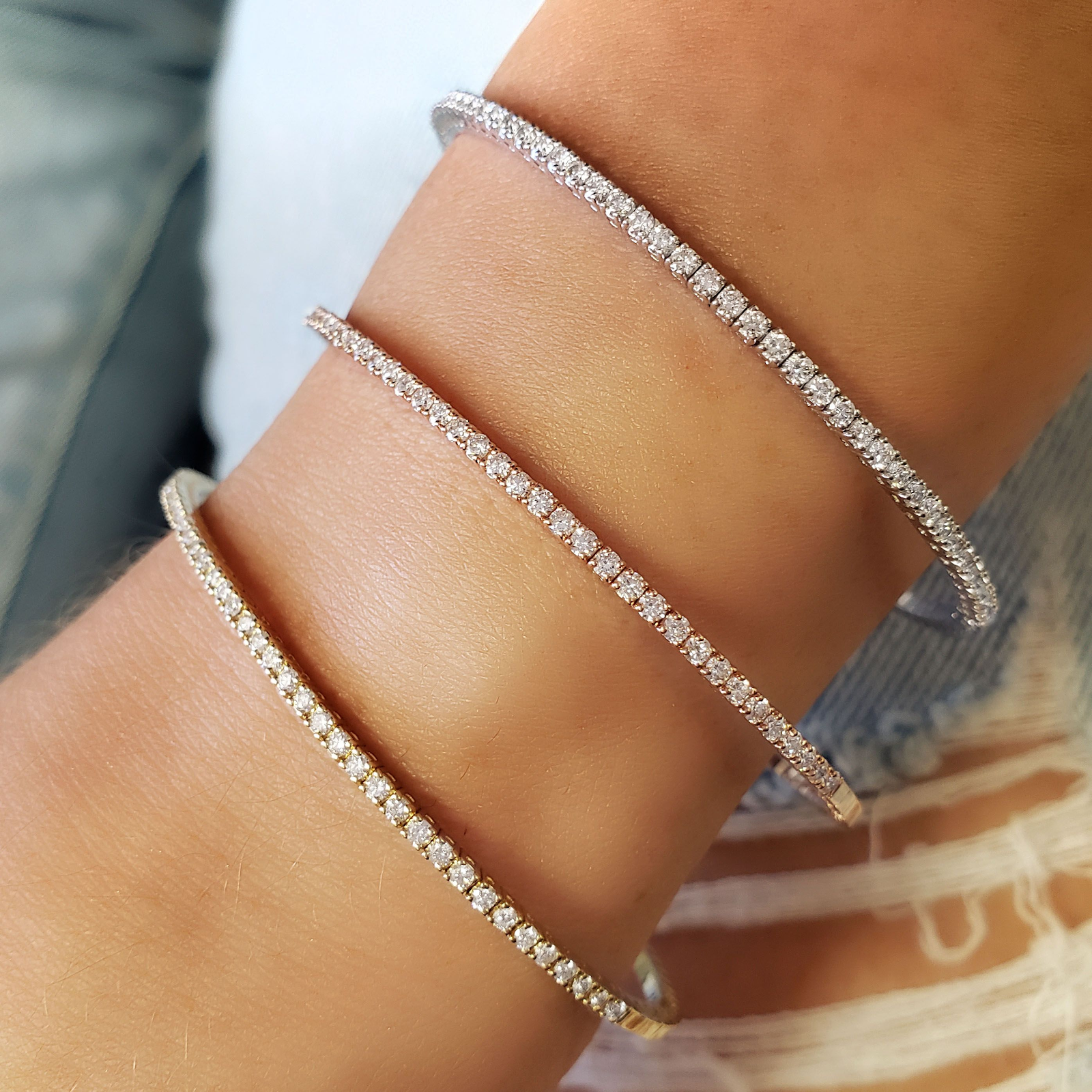
White gold and platinum make the diamonds look brightest. Yellow and rose gold give a warmer look and are lovely stacked with a watch. See is platinum better than gold for the trade-offs.
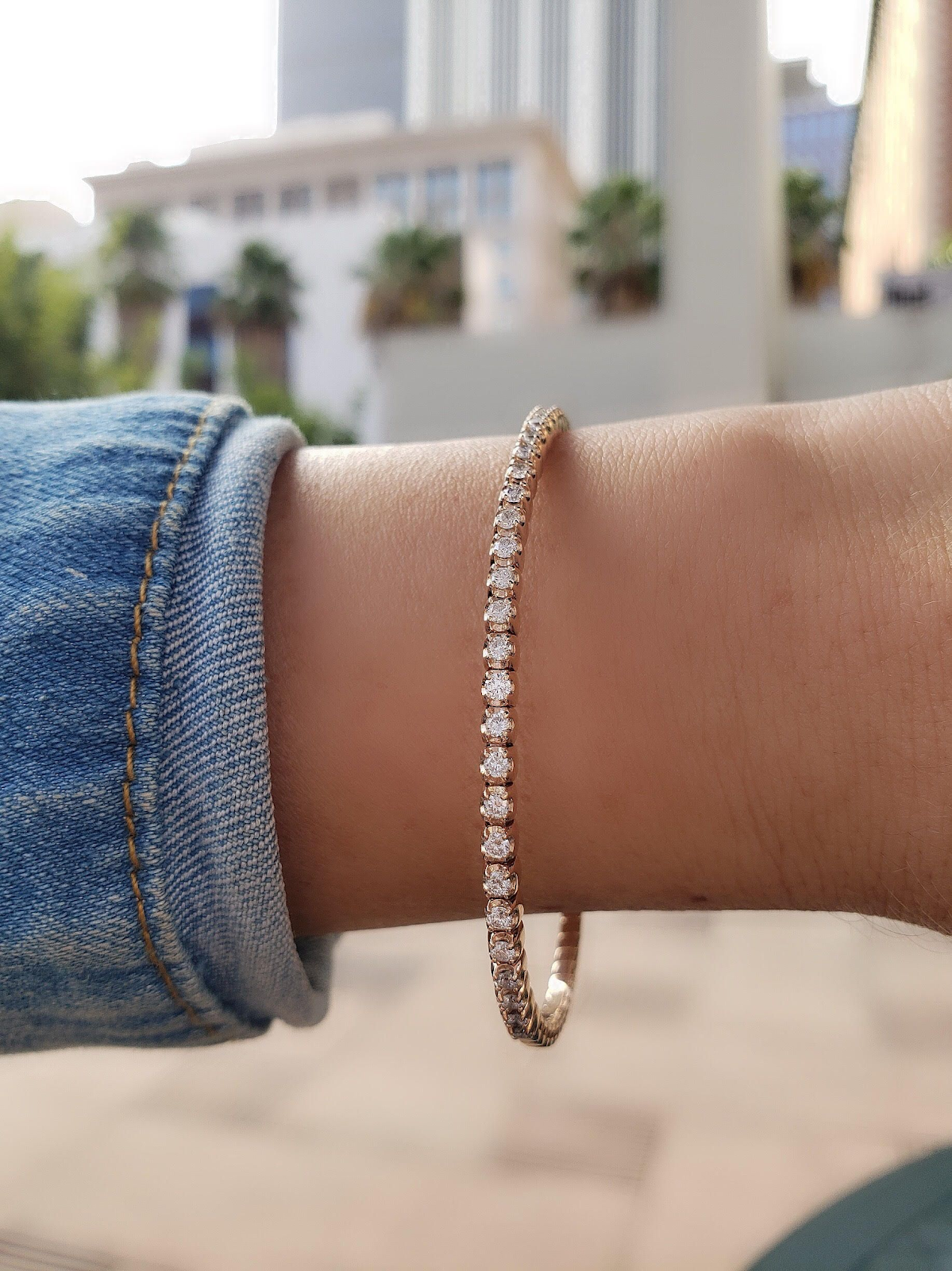
Look for a box clasp (the tongue clicks into a box) with a figure-eight safety latch on one or both sides. The safety latch is a small hinged loop that flips over and holds the bracelet closed even if the main clasp is knocked open.
Omid’s tip: Check the clasp before anything else. A box clasp with a figure-eight safety on each side is what you want. When a tennis bracelet gets lost, it’s almost always because of the clasp, not the diamonds, which is exactly what happened at the U.S. Open in 1987.
Measure the wrist snugly with a soft tape just below the wrist bone, then add about half an inch to three quarters of an inch for a comfortable fit. Many women wear around 6.5 to 7 inches; men usually wear 8 inches or more. A tennis bracelet should move a little but not slide far down the hand. We make each bracelet to order in your length.
Yes, and plenty do. Men tend to choose a slightly bolder line (larger individual diamonds or a channel setting) in a longer length, often worn with a watch.
Earrings need the same kind of attention; our guide to types of earring backs covers which backs are most secure.
They’re usually the same thing. “Eternity bracelet” was the common name before 1987.
Anything from about 1 carat to 20 carats or more. Bigger totals usually mean bigger individual diamonds.
Not when they’re well made. Weak clasps and worn links are the usual problems, which is why a double safety clasp and a yearly check matter.
It depends on total carat weight, diamond quality and certification. For example, our 10 carat GIA-certified tennis bracelet was about $15,000 in November 2026; check the product page for today’s price.
Start from one of our diamond tennis bracelets, choose the metal, length and diamond quality, and we make it to order. Our natural diamonds come from suppliers who follow the Kimberley Process and the System of Warranties. Only 1 in 20 natural diamonds makes our cut. Handcrafted in our Los Angeles workshop, serving clients nationwide.
Prefer something fully custom? Start a custom design. Questions? Call 1-800-518-0240 or text a designer.
About the author: Omid Semino is the founder of Diamond Mansion and has worked in the diamond business full time since 2010.

We understand shopping for diamond jewelry can be intimidating.
Subscribe to our newsletter & receive clear explanations, shopping tips, and personalized style advice delivered straight to your inbox.
9 months ago
In short: an eternity ring is a band set with a continuous row of matching diamonds, either all the way around (full eternity) or...
2 years ago
Stud earrings use one of three main types of back: push backs (also called friction or butterfly backs), screw backs, and guardian...
3 years ago
Diamonds as a mineral are not especially rare, but large, high-quality gem diamonds are. Each one also passes through mining, cutt...

Design your dream engagement ring at Diamond Mansion
Shop Engagement Rings